
I recently did a presentation about using German Archives. I used one of my ancestral towns, Delbrück, as an example. Delbrück is about a half-hour drive west of Paderborn in Germany. Someone in my audience suggested I create a blog post about this process, so here we are!
I knew that there were special contracts (Weinkäufe) available for this area. They are documents specifying details of a person acquiring rights to a farm. The arrangement often happened when a couple married, negotiated by their parents or guardians. There is a GenWiki article that refers to these documents and gives a clue to where they might be found. I’ll translate the important part:
“…the Weinkäufe can be found in the Ämterrechnungen [the invoices of the Amt] of the Principality of Paderborn. They are kept in the Münster State Archives.”
A few things to break down here. Amt is a word for district and is a type of small district in this region of Germany. As of 1912, the Amt was based in Delbrück. Up to 1806, the Amt for Delbrück was in Neuhaus. It was part of the Fürstbistum [Prince Bishopric] Paderborn. When I am searching the archival holdings, I want to look for Rechnungen [invoices or bills] in the Amt of Delbrück or Neuhaus. It is best to keep the German words in mind, rather than their English translations. This will all make sense shortly.
The state archives for North-Rhine Westphalia have undergone some slight name changes and restructuring since the GenWiki article was written. What used to be simply called the Münster State Archives is now the Münster branch of the Landesarchiv in Nordrhein Westfalen [State archive of North Rhine Westphalia]. They have very detailed finding aids online. Using the clues from above, let’s see if we can find the records we need. Spoiler alert, the records themselves are not online. We are looking for the archival signatures so we could hire someone or visit the archives ourselves.

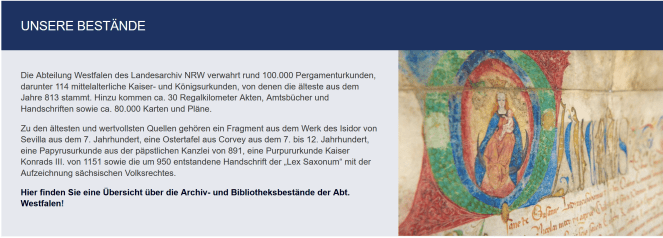
From this main page, scroll down a bit to find the banner “Unsere Bestände.” This means “our archival holdings.” Click the bottom link.
On this page, you see sections chronologically (keep scrolling to see them all):
- Territorien des Alten Reichs bis 1802/03 [Territories of the old Empire up to 1802/03]
- Behörden der Übergangszeit von 1802 bis 1816 [Authorities of the transition period from 1802–1816]
- Behörden und Einrichtungen des Staates und der Selbstverwaltung nach 1816 [Authorities and institutions of the state and self-government after 1816]

I would like to see the earlier Weinkäufe before 1802, so let’s start with the first section “Territories of the old Empire up to 1802/03.” Click on that link.
Now the full finding aid appears on the lower left side. It is in a tree structure and there are several levels that we need to explore. Recall that Delbrück in earlier years was under the control of the Fürstbistum Paderborn. For that reason, we want to click on “1.2 – Westfalische Fürstbistümer (B).

Once we click on that, we see a list of the Fürstbistümer in the area. Next we click on “1.2.2 Fürstbistum Paderborn.
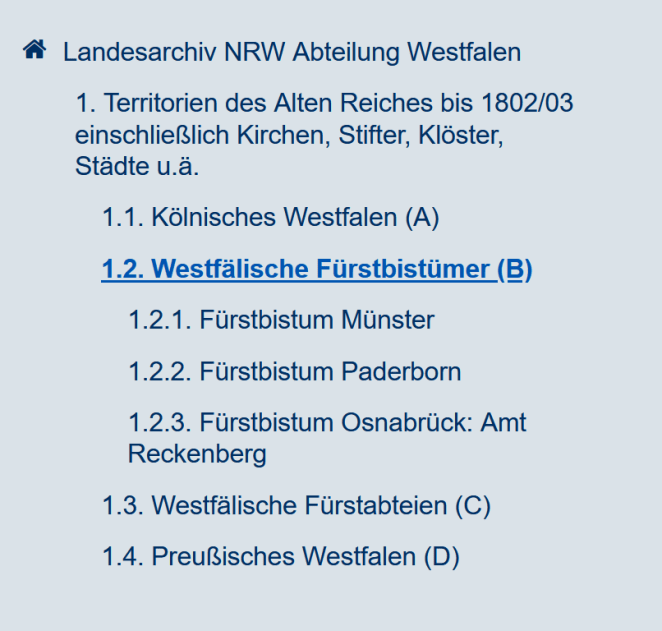
The tree keeps expanding. There are several options under “1.2.2 Fürstbistum Paderborn.” Next choose “1.2.2.1 – Verwaltung, Justiz, Landstände.” [Administration, Justice, Land holdings/estates]. Now keep scrolling until you see the word Rechnungen. Those are the records we seek. Click on “B 408 / Fürstbistum Paderborn, Rechnungen,” and scroll to find the Amt Neuhaus.

Numbers 7 and 9 both mention Neuhaus. If you choose Neuhaus-Boke, you will find very early records. Keep drilling down to 9.1 – Geldrechnungen, which are items paid with money. The Kornrechnungen in 9.2 are items paid with grain. On the right side you will see the many archival holdings in 9.1.

Each one spans a year or two (see Laufzeit) and the earliest are from 1673. The archival signature for the first one is B 408, Nr. 1123. The finding aid will not give you more details. But now you could visit the archive and request that signature number or any other ones you want to view. You will also want to explore number 7 for Neuhaus. Those records go back to 1531. The church records for this area begin in 1667, so these Rechnungen might help add a few more generations to a family! Let me know your questions.
Happy Hunting!
 Lind Street Research