
From German Girls Genealogy (Teresa Steinkamp McMillin & Debra A. Hoffman):
This series of posts, continued from our prior post, outlines our preparation for a German trip to research beyond church records. Now that your archives have been identified and your trip is all planned, the next step is planning how you will stay organized on your research trip.
Research Notes
You have invested a lot of time, money, and effort to get to the archives you will visit. Do not leave there, not knowing what you looked at or how to find images of the records you reviewed. Take good notes about each archive you visit. Even before you start looking at books, note any details about accessing the archives. Is the main entrance facing the street or is it on the side of the building? Note any costs for admission. Are there lockers to store your coats and bags? Do you need a coin for the lockers? What is the general layout of the archive, e.g., is the reading room on the second floor, are there interesting exhibits on the first floor? Are there certain times when the archive will pull records? What are you doing about eating and drinking? Are there facilities onsite or restaurants nearby or will you take a snack and water with you? We stored water and snacks in our locker that we could take outside to eat. Also, remember your converter and cords to keep your computer and phone charged.
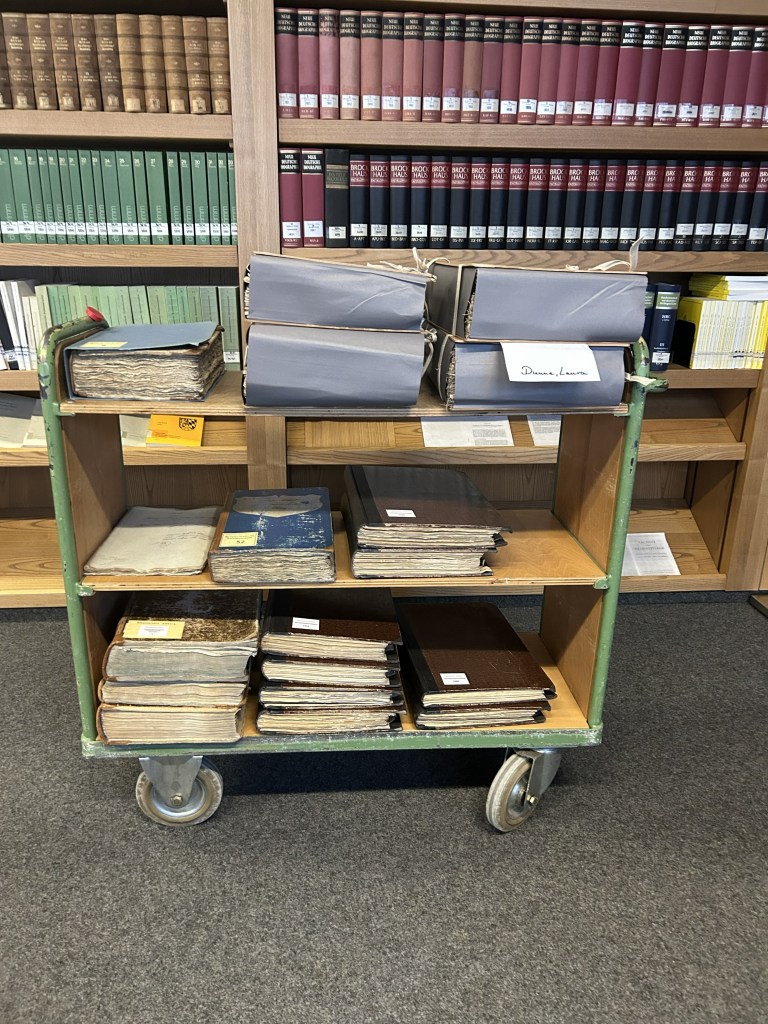
Once you are viewing the records that you have requested, make notes about what it is, its condition, the format (microfilm, bound book, loose paper). Is there an index? Is it chronologically arranged, or in some other order? Make notes about significant findings. Make notes when you find nothing and be clear about how much of the item you looked at. Include information about how many images you took with your camera (if allowed) or any photocopies you requested. Note where these images are stored on your computer.
Digital Images
Before you arrive at the archive, you should already know what devices (laptop, camera, portable scanner) you can have with you. Many archives that we visited allow you to take photographs of documents at no cost. Some have over-sized scanners onsite and you may scan images to a flash drive. Some archives count the scans made and charge a nominal fee.
At one archive, we were using microfilm. We were able to copy those images to a flash drive. No matter the technology or the device you’re using, be sure to capture an image of the archival signature, the front cover, and any introductory material in addition to the pages of interest.
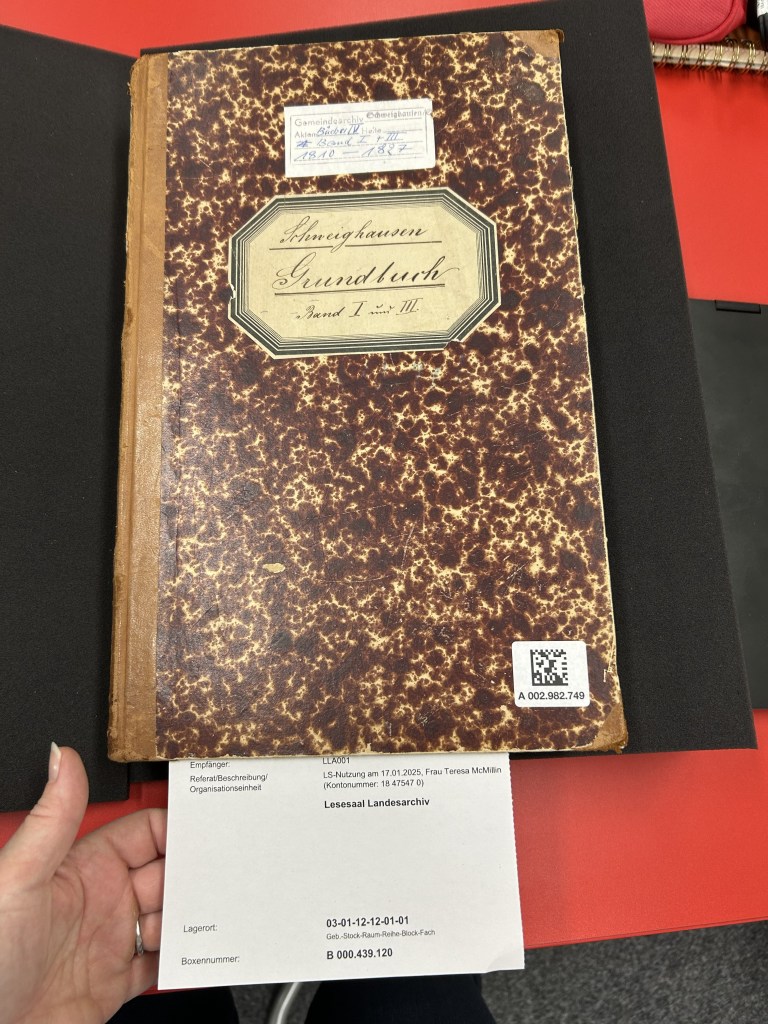
If you have time and Wi-Fi, it’s a good idea to transfer images from your phone to your computer while at the archive. We like to make a digital folder for each archive, then subfolders for each archival item labeled with the archival signature. The images collected will go into their appropriate folder. There may be reasons for creating more subfolders. Place your notes in the relevant folder(s).
If you are short on time at the archive, be sure to upload your images later that day. Do not wait until you get home to do this, as it is easy to forget details and possibly lose something.
Paper Copies
Some archives only allow paper copies to be made. My experience at these archives is that they control the copying process. You request the items you want copied and they give them to you as they are ready. Sometimes you will get your copies at the end of the day. Typically, you will pay for these in one total before you leave.
If you are working with paper copies, come prepared with folders to hold them and keep them organized.
Final Notes
Most likely, you will find items faster than you can read them fully. Depending on your German language skill, you might find names of interest but will need help translating the full document. Be sure to get all relevant pages, not just the page with the name on it. Once home, you can take time reading the full item or get help with the translations.
 Lind Street Research