
From German Girls Genealogy (Teresa Steinkamp McMillin & Debra A. Hoffman):
Our last series of posts outlined preparation for a German trip to research beyond church records. We now want to highlight some of our findings to demonstrate how your hard work can pay off.
Beraine – Land Records
The Generallandesarchiv Karlsruhe holds a large collection of land records in 66-Beraine. It has no online finding aid, rather a large set of index cards held in a filing cabinet. The index cards are alphabetically arranged by place name and they point to microfilms, which ultimately contain images of the records.

I was focused on my Huber family who lived in Butschbach. The “land” records I found for that location were more akin to tax assessment lists. I’ll show you an example. Unfortunately, the images are very faint, but they are legible.
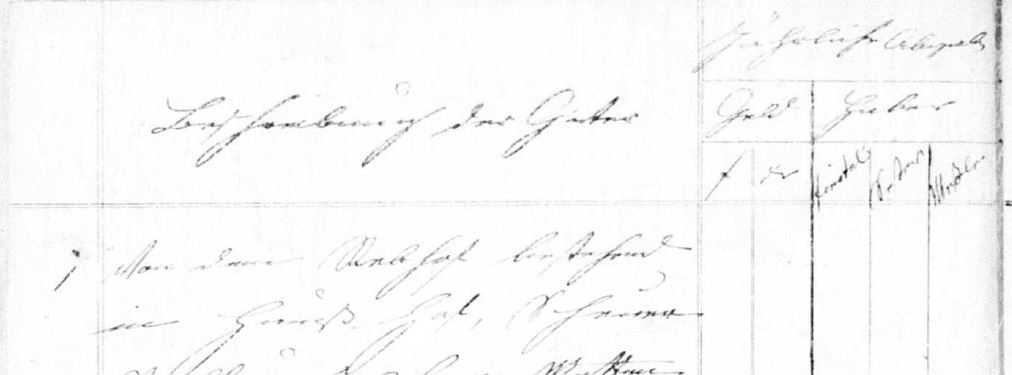
This example is from 1825 for Butschbach.[1] Each page describes a Gut [farm] and its annual taxes. The taxes fall into two categories: money and grain. The currency for Baden at the time were Florin, subdivided into Kreuzer. The measurement for grains, from largest to smallest, were Fiertel, Sester, and Meßlein. Every region had its own units of measure. Sometimes they had the same or similar names, but they might equate to different amounts. One of the archivists alerted us to a great book for weights and measures in Baden: Wolfgang and Hippel, Maß und Gewicht im Gebiet des Großherzogtums Baden um 1800 [Measurements and weight in the area of the Grandduchy of Baden around 1800] (Mannheim: Institut für Landeskunde und Regionalforschung der Universität Mannheim, 1996).
The description of the farm was interesting. It lists the types of buildings on the property and names of adjacent neighbors. For example, the first Gut belonged to Joseph Braun. His neighbors included Doctor Bauhöfer, Michael Spinner, Anton Huber, and Joseph Huber. On Braun’s property there a house, yard or garden, barn/stable, agricultural land, meadow, vineyard, forest, and Wildfeld [I believe this to be fallow ground.]
At a first glance, these records might not tell you a lot. But if you really study them, you can see what a typical farm might look like. You can determine who the neighbors are. You can get clues about your ancestor’s wealth compared to their neighbors. It adds more to the information that you get from the church records.
[1] Butschbach und Hesselbach Beraine, 1825, Vol. VI, no. 1, Joseph Braun; Generallandesarchiv Karlsruhe, microfilm, 66-Beraine, Nr. 1542, third image.
 Lind Street Research